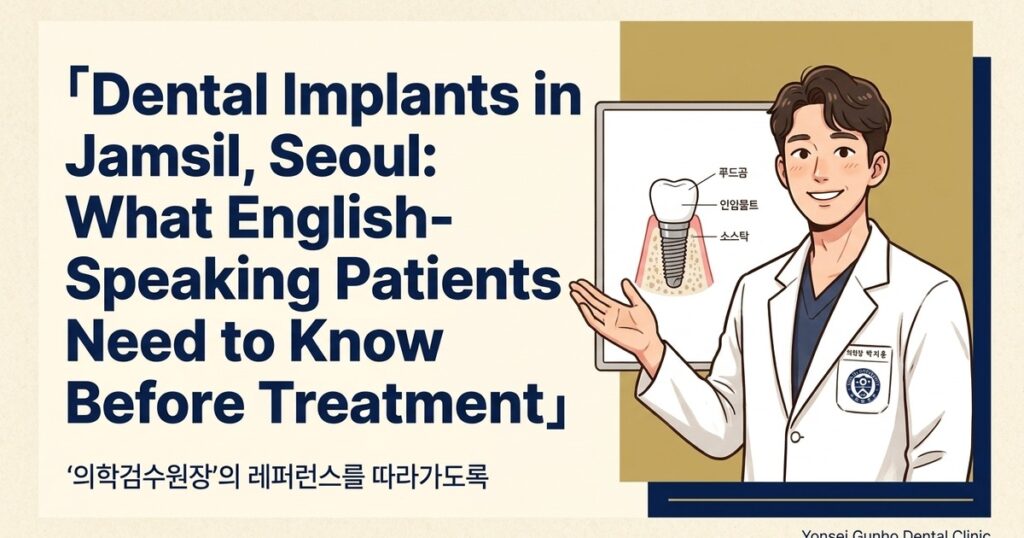
Dental Implants in Jamsil, Seoul: What English-Speaking Patients Need to Know Before Treatment
Key Takeaways
This article covers the complete dental implant process for expats, international students, and medical tourists seeking treatment in the Jamsil (잠실) area of Seoul, including what to expect at each stage, typical timelines, and how to navigate care when Korean isn’t your first language.
- A dental implant is a titanium post surgically placed into the jawbone to serve as an artificial tooth root, typically requiring 3–6 months from placement to final crown.
- Bone grafting or sinus lift procedures may add 4–6 months to your treatment timeline if jawbone density is insufficient.
- Clinics with board-certified oral and maxillofacial surgeons handle the surgical placement, while prosthodontists design and fit the final restoration for optimal function.
- English-speaking patients in Korea can reduce uncertainty by choosing clinics that offer specialist consultations and clear communication about each treatment phase.
If you’re living in Seoul as an expat, studying abroad, or visiting Korea for medical care, losing a tooth raises immediate questions: Where do I go? Will someone explain things in English? How much time will this take? These concerns are entirely valid, especially when navigating a healthcare system in a second language. This guide walks you through the dental implant process as it’s practiced in the Jamsil and Songpa (송파) areas, so you can approach treatment with realistic expectations and confidence.
What Is a Dental Implant and Who Is a Good Candidate?
A dental implant is a small titanium post that an oral surgeon places directly into your jawbone, where it fuses with the bone over several months to create a stable foundation for a replacement tooth. Unlike dentures or bridges, implants don’t rely on neighboring teeth for support. They function independently, which helps preserve surrounding tooth structure and prevents the bone loss that typically follows tooth extraction.
Not everyone qualifies for immediate implant placement. Your dentist will evaluate several factors during the initial consultation:
- Jawbone density and volume: Adequate bone is essential for the implant to integrate properly. If bone has resorbed after tooth loss, grafting may be necessary first.
- Gum health: Active periodontal disease must be treated before implant surgery to reduce infection risk.
- Overall health status: Uncontrolled diabetes, certain autoimmune conditions, or medications affecting bone metabolism may require additional precautions.
- Smoking habits: Tobacco use significantly increases implant failure rates. Dentists typically recommend quitting or reducing consumption before and after surgery.
For patients who have been told elsewhere that they’re “not a candidate,” it’s worth seeking a second opinion. Advances in bone grafting and surgical techniques have expanded treatment possibilities considerably. Before considering an implant, some patients explore whether a damaged tooth can be preserved through other treatments—a conversation worth having if extraction isn’t yet certain.
How Long Does the Implant Process Take from Start to Finish?
Most straightforward implant cases require 3–6 months from surgical placement to final crown delivery, though complex situations involving bone grafting may extend treatment to 9–12 months. This timeline surprises some patients, but the wait serves a critical purpose: osseointegration.
Osseointegration refers to the biological process by which living bone cells grow around and bond to the titanium implant surface. Rushing this phase risks implant failure. Your surgeon will schedule follow-up appointments to monitor healing and determine the right moment to proceed with the restoration phase.
| Treatment Scenario | Estimated Timeline | Key Factors |
|---|---|---|
| Standard single implant (adequate bone) | 3–4 months | No grafting needed; healthy healing response |
| Implant with minor bone graft | 4–6 months | Small graft placed simultaneously with implant |
| Implant requiring staged bone graft | 6–9 months | Graft must heal 4–6 months before implant placement |
| Upper molar with sinus lift | 6–12 months | Sinus membrane elevation adds healing time |
| Implant revision (failed previous implant) | 6–12 months | Removal, site healing, and regrafting often required |
For international patients with limited time in Korea, it’s important to discuss scheduling constraints upfront. Some stages can be planned around travel dates, and temporary restorations can maintain aesthetics while you’re waiting for the final crown.
Step-by-Step: What Happens During Implant Treatment?
Understanding each phase of implant treatment reduces anxiety and helps you plan appointments around work, study, or travel schedules. Here’s what a typical implant journey looks like:
- Step 1: Comprehensive Examination and Planning
Your first visit includes a detailed oral examination, 3D cone-beam CT imaging, and a review of your medical history. The CT scan reveals bone dimensions, nerve locations, and sinus proximity—information essential for safe implant positioning. This appointment typically takes 45–60 minutes. - Step 2: Treatment Plan Discussion
The surgeon reviews your imaging results and explains the proposed approach, including whether bone grafting is necessary. You’ll receive a written treatment plan with an estimated timeline. This is the right moment to ask questions about anesthesia options, post-operative care, and scheduling logistics. - Step 3: Implant Placement Surgery
Under local anesthesia (sedation available for anxious patients), the oral surgeon creates a small opening in the gum tissue and prepares the bone site using specialized drills. The titanium implant is then inserted and the gum tissue closed with sutures. The procedure itself takes 30–60 minutes per implant. Most patients experience mild to moderate discomfort for 2–3 days, manageable with prescribed pain medication. - Step 4: Osseointegration Period
Over the next 2–4 months, the implant fuses with surrounding bone. During this time, you’ll have periodic check-ups to monitor healing. If you had a front tooth extracted, a temporary restoration maintains your appearance. - Step 5: Abutment Placement
Once osseointegration is confirmed through imaging and clinical assessment, a small connector piece called an abutment is attached to the implant. This minor procedure requires only local anesthesia and heals within 1–2 weeks. - Step 6: Final Crown Fabrication and Delivery
A prosthodontist takes impressions or digital scans of the implant site and surrounding teeth. A dental laboratory fabricates a custom crown matched to your natural tooth color and shape. After final adjustments to ensure proper bite alignment, the crown is secured to the abutment. This phase requires 2–3 appointments over 2–3 weeks.
Digital planning technology, including navigation-guided implant surgery, allows surgeons to virtually position implants before the actual procedure. This approach improves precision, particularly in cases with limited bone or proximity to nerves.
A note from Dr. Park Ji-ho, Oral and Maxillofacial Surgeon
Patients often underestimate the importance of the healing period. I know it’s tempting to rush toward the final crown, but giving bone adequate time to integrate with the implant is what makes the difference between a restoration that lasts decades and one that fails within years. Patience during osseointegration is genuinely an investment in long-term success.
Do I Need Bone Grafting or a Sinus Lift?
Bone grafting becomes necessary when the jawbone lacks sufficient height, width, or density to support an implant—a common situation if teeth have been missing for months or years. Without intervention, placing an implant in inadequate bone risks poor integration, implant mobility, or outright failure.
A sinus lift, also known as sinus floor elevation, is a specific type of bone graft performed in the upper jaw. The maxillary sinus—an air-filled cavity above your upper molars—often expands downward after back teeth are lost, leaving minimal bone between the sinus floor and the oral cavity. During a sinus lift, the surgeon gently elevates the sinus membrane and places bone graft material beneath it, creating sufficient depth for implant placement.
Bone graft materials include:
- Autogenous bone: Harvested from another site in your own mouth or body. Considered the gold standard for integration, though it requires a secondary surgical site.
- Allografts: Processed human donor bone from a tissue bank. Widely used with reliable outcomes.
- Xenografts: Derived from bovine (cow) bone. Serves as a scaffold for new bone growth.
- Synthetic materials: Lab-created bone substitutes that gradually resorb as natural bone replaces them.
The need for grafting doesn’t mean you’re a poor candidate for implants—it simply means treatment requires an additional step. Many patients who initially hear “you don’t have enough bone” successfully complete implant treatment after proper grafting procedures.
Front Teeth vs. Molars: Does Implant Location Matter?
Yes, implant location significantly affects surgical approach, aesthetic considerations, and the type of restoration used. Front teeth and back teeth present distinct challenges that require different expertise.
For front tooth (anterior) implants:
- Aesthetics are paramount. The implant must be positioned precisely to ensure the final crown emerges naturally from the gum line.
- Bone in the front of the mouth is often thinner and more prone to resorption after tooth loss.
- Gum tissue thickness and contour directly affect appearance. Soft tissue grafting may be needed to achieve natural-looking results.
- Patients typically need a temporary restoration during healing to maintain appearance in social and professional settings.
For molar (posterior) implants:
- Bite forces are substantially higher, requiring implants with wider diameters and secure integration.
- Upper molars often involve sinus proximity, necessitating sinus lift procedures.
- Lower molars require careful planning to avoid the inferior alveolar nerve, which runs through the mandible.
- Aesthetic concerns are less critical, but functional restoration of chewing ability takes priority.
Some patients wonder whether damaged front teeth should be extracted for implants or restored with crowns or veneers. The answer depends on remaining tooth structure and root health. If you’re weighing these options, understanding the differences between crowns and veneers helps clarify which approach preserves more natural tooth.
What Should I Know About Implant Revisions and Complex Cases?
Implant revision refers to the process of removing a failed or failing implant and, when possible, placing a new one after the site has healed and been properly prepared. Revisions are more complex than initial implant placement, but they’re not uncommon—and they don’t mean you’re out of options.
Common reasons implants fail include:
- Peri-implantitis: A bacterial infection causing bone loss around the implant, similar to periodontitis around natural teeth. Early-stage peri-implantitis can sometimes be treated non-surgically, but advanced cases may require implant removal.
- Failed osseointegration: The implant never properly bonded with bone, remaining mobile rather than stable. This typically becomes apparent within the first few months.
- Mechanical complications: Fracture of the implant body, abutment, or screw. Though rare with modern implant systems, these issues require component replacement or complete revision.
- Improper initial positioning: An implant placed at the wrong angle or depth may cause bite problems, aesthetic issues, or difficulty cleaning. Revision may be the only solution.
The revision process typically involves removing the failed implant, allowing soft tissue to heal for several weeks, grafting the site if bone was lost, waiting 4–6 months for graft maturation, and finally placing a new implant. Total timeline: often 9–12 months.
Patients who have experienced implant failure elsewhere understandably feel hesitant about trying again. Working with board-certified specialists—an oral surgeon for placement and a prosthodontist for restoration—improves outcomes in complex revision cases. In certain situations, advanced techniques like intentional replantation may even salvage compromised teeth that would otherwise require extraction and implant replacement.
Older adults sometimes assume they’re too old for implants. In reality, age alone isn’t a contraindication. Overall health, bone quality, and ability to maintain oral hygiene matter far more than the number on your birthday. Many patients in their 70s and 80s successfully receive implants and enjoy years of comfortable function.
Conclusion: Finding the Right Implant Care in Songpa District
Dental implant treatment represents a significant investment of time, resources, and trust. For English-speaking patients navigating the Korean healthcare system, finding a clinic that combines clinical expertise with clear communication makes the process considerably less stressful.
Key points to remember as you evaluate your options:
- Expect the full implant process to take 3–6 months for straightforward cases, longer if bone grafting or sinus procedures are needed.
- Ask about the qualifications of the professionals involved. Oral and maxillofacial surgeons handle the surgical aspects; prosthodontists specialize in designing functional, natural-looking restorations.
- Don’t assume that one consultation gives you the complete picture. Complex cases benefit from thorough evaluation and realistic timeline discussions.
- If you’ve been told you’re not a candidate due to bone loss, seek a second opinion. Modern grafting techniques have expanded treatment possibilities significantly.
Yonsei Gunho Dental Clinic (연세건호치과의원), located in Jamsil within Seoul’s Songpa-gu district, offers convenient access from Jamsil Saenae Station (Line 2) and Sports Complex Station (Lines 2 and 9)—both within a 5-minute walk along Olympic-ro. The clinic’s team includes board-certified specialists from Yonsei University College of Dentistry, with oral surgeons managing implant placement and prosthodontists overseeing final restorations. For patients who feel anxious about dental procedures, the clinic emphasizes a calm, reassuring environment.
If you’re considering implant treatment in the Jamsil area and would like to discuss your specific situation, consultations are available by phone at 02-6956-9949.
This article is provided for general dental health information only and is not a substitute for professional medical advice on a specific diagnosis or treatment. Treatment methods, duration and outcomes vary with each patient’s oral condition, so please consult a dentist directly for an accurate diagnosis and treatment plan.
Frequently Asked Questions (FAQ)
How many visits are needed for a dental implant in Korea?
A standard implant case typically requires 4–6 visits spread over 3–6 months. The first visit covers examination and imaging. The second is for surgical placement. Follow-up appointments monitor healing, and final visits involve abutment placement and crown delivery. Complex cases requiring bone grafts may add 2–3 additional appointments.
Can I get a dental implant if I’m only in Seoul for a few months?
Partial treatment is possible within a limited timeframe. Consultation, imaging, and implant placement can often be completed within 2–3 weeks. However, you’ll need to return after 3–4 months for the final crown, or coordinate with a dentist in your home country to complete the restoration phase. Discuss your travel schedule during the initial consultation.
Does Korean national health insurance cover dental implants?
Korean national health insurance provides partial coverage for implants only for patients aged 65 and older, covering two implants per person with a patient copay. For most expats and international patients under 65, implants are not covered by national insurance. Private international insurance policies vary, so check your specific plan details.
How painful is dental implant surgery?
Most patients report less discomfort than expected. The procedure is performed under local anesthesia, so you won’t feel pain during surgery. Post-operative discomfort typically peaks on days 1–2 and is manageable with prescribed pain medication. Many patients return to normal activities within 2–3 days, though strenuous exercise should be avoided for about a week.
What’s the difference between a regular implant and a navigation-guided implant?
Navigation-guided (or digitally-planned) implant surgery uses 3D CT imaging and computer software to plan exact implant positioning before surgery. During the procedure, the surgeon follows this digital plan for precise placement. This approach is particularly valuable in complex cases with limited bone, proximity to nerves, or high aesthetic demands. Standard implants use the same titanium posts but rely on the surgeon’s clinical judgment during placement rather than digital guidance.